
In Plato's Gorgias, Socrates wants Polus, a young follower of the sophist Gorgias, to bear witness to Socrates' claim that Socrates, Polus, and everyone else would rather suffer injustice than do injustice (Gorgias 474b2-4). Socrates is concerned with this question because if Polus concedes it will support Socrates' overarching argument in the Gorgias that he who does injustice and gets away with it is more miserable than he who does injustice and is justly punished (472e4-7). Socrates succeeds in persuading Polus that everyone would rather suffer injustice than do injustice; however, Socrates does not succeed because his argument is sound, but because he presents an ambiguous and incomplete conception of what it is to be 'more shameful' in his argument, and he usurps the incompleteness of his argument to trivialize the decision between doing injustice and suffering injustice that Socrates ultimately calls upon Polus to make. I am unconvinced by Socrates' argument because I see that Polus is deceived by Socrates near the end of the argument when Socrates asks him to choose "what's more evil and…more shameful over what is less so" (475d6-7).
The Structure of the Argument
The argument begins when Socrates asks Polus which is worse, "doing what's unjust or suffering it," (474c4-5) to which Polus replies that suffering what is unjust is worse (Premise I, 474c6). Socrates proceeds to question Polus, asking whether doing what is unjust or suffering what is unjust is more shameful (474c7-8); Polus tells Socrates that doing what is unjust is more shameful (II, 474c9). Polus explains that although he believes doing injustice is more shameful, it is not worse than suffering injustice, explaining that more shameful does not imply worse (III, 474c10-11). Socrates, citing the exclusivity of worse and shameful, leads Polus to agree that shameful and bad are different (IV, 474d1-3), and Socrates suggests that the respective opposites of bad and shameful, good and admirable are different as well (474d1-2). Polus agrees (V, 474d3).
After this, Socrates provides an inductive definition for admirable, showing that that which is admirable is so called "in virtue of [its] usefulness, relative to whatever it is that each [of its kind] is useful for, or else in virtue of some pleasure" (474d4-11), and Polus agrees that to be admirable is to be useful or pleasurable (VI, 474e1); Polus agrees with Socrates that to be admirable is to be pleasurable or beneficial or both (VIb, 474e2-5); Polus says to Socrates "your present definition of the admirable in terms of pleasure and good is an admirable one" (VIc, 475a4-5). Socrates suggests, and Polus immediately agrees, that as admirable stands in relation to good and pleasure (VIc), so too does shameful, the opposite of admirable, stand in relation to evil and pain, the opposites of good and pleasure; something is shameful on account of either some evil or pain or both (VII, 475a6-8).
Socrates asks Polus if it follows from VIb that when two things are admirable, one is more admirable than the other if it surpasses the other in pleasure, benefit, or both (475a9-11). Polus says that it does (VIII, 475a12). Socrates asks if it also follows from VII that when one of two shameful things is more shameful than the other, it is because the one that is more shameful surpasses the one that is less shameful in either pain, evil, or both (475a13 - 475b2). Again, Polus says that it follows (IX, 475b3). Socrates reminds Polus of I and II (475b4-7), and they agree that doing injustice, because it is more shameful, must surpass suffering injustice in either pain or evil or both (X, 475b8-12), and it is agreed that doing injustice does not surpass suffering it in pain (XI, 475c1-5).
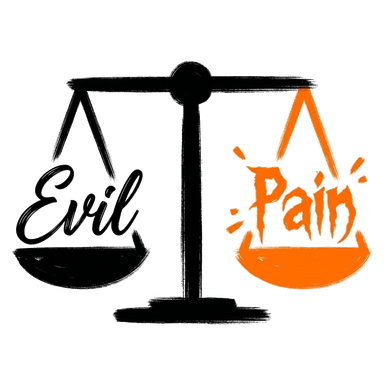
Socrates shows that it follows from IX, X and XI that doing injustice must surpass suffering injustice in evil; one thing is more shameful than another when it surpasses the other in pain or evil or both (IX), doing injustice must surpass suffering it in pain or evil or both (X), and doing injustice does not surpass suffering injustice in pain (XI); therefore, doing injustice must surpass suffering injustice in evil (XII, 475c6-12). To conclude the argument, Socrates asks Polus what appears to be a straightforward question: "would you then welcome what's more evil and what's more shameful over what is less so?" (475d6-7) to which Polus replies "no, I wouldn't… [and neither would any other person]" (XIII, 475e1-3). Polus is convinced that neither him nor Socrates nor any other person would prefer doing what is unjust to suffering it.
The Unsoundness of the Argument
Although Socrates succeeds in convincing Polus that everyone would prefer doing what is unjust to suffering it, it is important to realize that Socrates' argument contains many inconsistencies and implicit substitutions which weaken many of its premises and the inferences made between them, rendering the argument unsound. The argument is found to be unsound when premises IV and VI are shown to deal with essential terms including 'worse,' 'bad,' 'useful,' etc. frivolously, and when premises IX, X, XI and XII are used to invalidate the final premise.
In premise IV, Socrates and Polus agree that what is more shameful is not necessarily what is worse, and they conclude that shameful and bad are different. Here, 'worse' becomes 'bad' when the difference between the two is crucial: finding five dollars is worse than finding twenty dollars, but finding five dollars is not bad. In premise VI, Polus agrees with Socrates that what is admirable is useful or pleasurable. Immediately, Socrates suggests that something is admirable "on account of either some pleasure or benefit or both" (474e9-10), abandoning the criterion of usefulness. Soon thereafter, 'admirable' undergoes yet another change, this time on Polus' behalf, from what is pleasurable or beneficial to what is pleasurable or good (475a4-5). Socrates does not account for the implicit transition from useful to good, and neither can I for that matter: for doing injustice, poison is useful; therefore, is it beneficial, good, and admirable?
The entire argument is undermined by this capriciousness when later premises, namely VII and VIII, are formed using inferences from these haphazard definitions. The most detrimental inconsistency in Socrates' argument is found upon scrutiny of the premises that lead to premise XIII. Polus says that suffering injustice is worse than doing it (I) and doing injustice is more shameful than suffering it (II). Socrates combines these first premises with the conception of 'more shameful' as what surpasses something else in either evil or pain or both (IX) and that suffering injustice surpasses doing injustice in pain (XI). Suffering injustice surpasses doing injustice in pain and doing injustice surpasses suffering injustice in evil (XII), so premise IX shows that suffering injustice and doing injustice are each more shameful than the other, causing premise II to be both true and not-true.
The Concealed Incompleteness
Socrates conceals the double-edged application of his conception of 'more shameful' when he asks Polus "would you then welcome what's more evil and what's more shameful over what is less so?" (475d6-7) If either Socrates or Polus had asked instead, "would you then welcome what's more painful and harmful and what's more shameful over what is less so?" the final premise could have reversed the conclusion. Even if Polus had not been deceived, and had been asked instead to decide between what is more painful (and shameful) and what is more evil (and shameful), it is far from certain that Socrates would have premise XIII to complete his argument. Socrates fails to present a complete understanding of what it is to be 'more shameful' in his argument, benefits from the flexibility afforded by this incompleteness, and conceals this incompleteness from Polus where it could compromise the argument.
The Broader Context
Socrates is concerned with the question of whether or not everyone would prefer suffering injustice to doing injustice because, if Polus concedes, Polus would have to agree that in acting unjustly, tyrants and orators alike are not doing what they want (466e1-2); in not doing what they want, orators are powerless (466d5-6); in that they are powerless, orators are held in no regard in their cities (466b4); oratory is flattery (463b1); oratory is not admirable (463a3-4). In the Gorgias, Socrates wants to show that doing what is unjust is a greater evil than suffering what is unjust (474b1-2), and that doing what is unjust and getting away without being justly punished is the greatest evil of all (479c7-8). Socrates does this to prove ultimately that doing injustice and getting away with it is more miserable than doing injustice and being justly punished (472e4-7).
Polus is convinced that this is so, and that oratory is no admirable craft but a means of concealing injustice; however, I am not convinced that everyone would be less miserable choosing pain over evil, one reason among many being that most people are more familiar and less comfortable with the effects of pain than those of evil. If I were forced to choose between a decade of an unknown pain and an hour of an unknown evil, I believe I could choose the hour of evil and end up less miserable. Socrates would respond to this by arguing that if you were to choose evil over pain, you would not be choosing what you really wanted. I would respond to this objection by saying that you would not be choosing what Socrates really wanted. If only the decision between pain and evil were as simple as Socrates makes it seem.


